Patients investing in smile makeovers often worry that their new teeth might look unnaturally opaque or chalky white. When evaluating aesthetic options, understanding how to choose natural veneer tooth shade options, colorimetry science, and skin complexion guidelines ensures your porcelain restorations blend harmoniously with your facial features. For zero-prep candidacy details, review our no prep vs traditional veneers comparison guide.
Clinical colorimetry standards established by the VITA Bleachedguide 3D-MASTER system evaluate tooth color across three physical dimensions: Value (lightness), Chroma (saturation), and Hue (color family). At Dental NKT, Doctor Nguyen Thu Hoai utilizes digital spectrophotometers and master hand-layered Emax disilicate ceramics to customize porcelain shades to match your unique aesthetics. Explore our specialized porcelain veneers service guide page for all restorative options.
In this clinical guide, Doctor Nguyen Thu Hoai, Senior Cosmetic Prosthodontist at Dental NKT, details bleach shade spectrums (BL1 to BL4), matching porcelain tones to skin complexions and eye sclera brightness, and creating micro-translucency edges to prevent a fake chalky appearance. Check our Dental NKT International Pricing Directory for all-inclusive treatment fees.
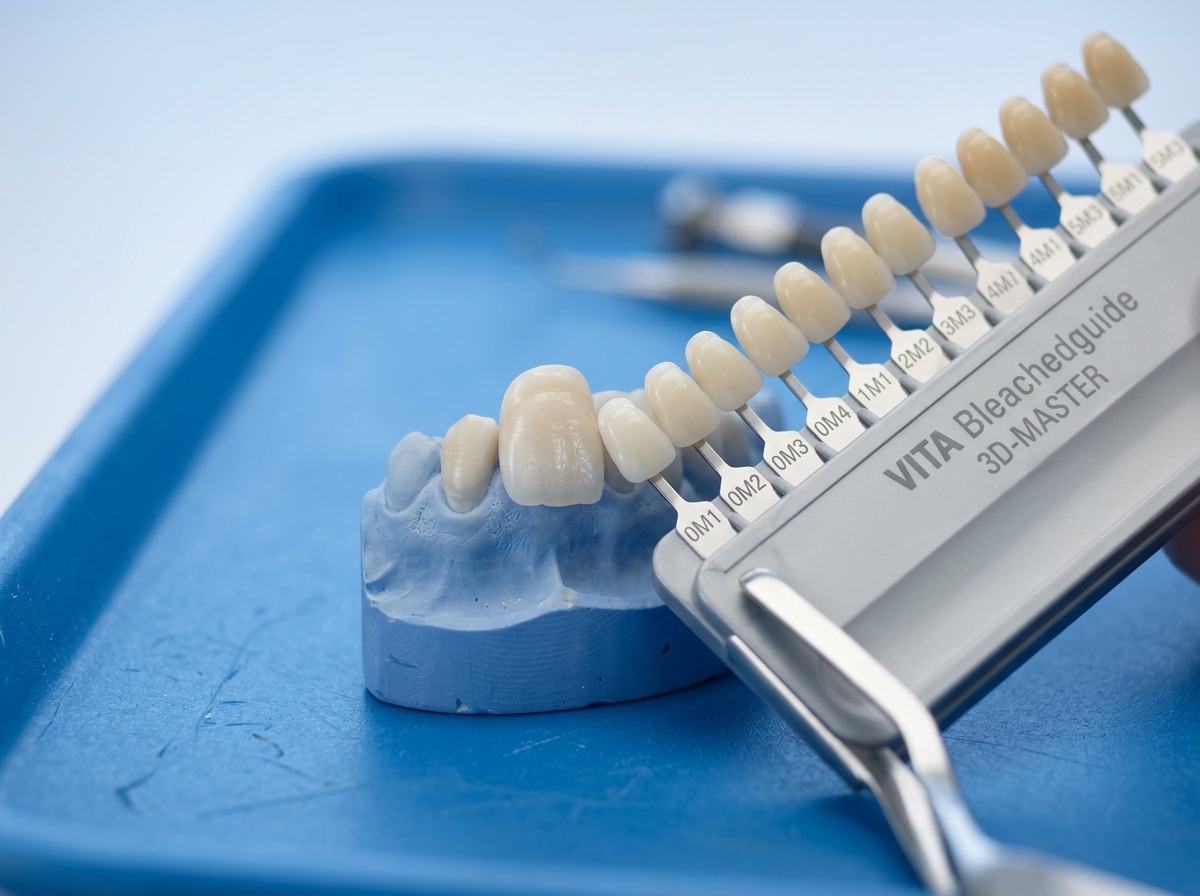
What Is the Difference Between Bleach Shades BL1, BL3, BL4, and A1?
Featured Snippet Summary: BL1 provides an intense ultra-white Hollywood look, BL2 and BL3 offer luminous natural brightness, while BL4 and A1 deliver soft, warm tooth tones ideal for subtle enhancements.
Choosing the ideal porcelain shade requires understanding the standardized VITA Bleachedguide scale, which extends beyond natural tooth color spectrums:
How Do Specific Porcelain Shade Tabs Compare?
Cosmetic dentistry specialists compare four popular shade categories:
- BL1 (Hollywood Ultra-White): The highest value (brightest) bleach shade, creating a dramatic, high-visibility white smile favored for camera and stage lighting.
- BL2 & BL3 (Luminous Radiant Bright): Luminous bleach shades that reflect strong brightness while retaining natural translucency, making BL3 the most popular choice for modern smile makeovers. Read about antibiotic masking in our veneers for tetracycline stained teeth guide.
- BL4 & A1 (Natural Warm Brightness): Soft, elegant shades that mimic youthful untreated enamel, blending seamlessly with surrounding natural teeth for subtle restorations. Read about material upgrades in our replacing composite bonding with veneers guide.
How Do You Match Veneer Shades to Skin Complexion and Eye Sclera Tone?
Eye Sclera Aesthetic Guideline: A widely used rule of thumb suggests matching tooth lightness to the natural brightness of the eye sclera to maintain facial visual balance.
A shade that looks stunning on one person may appear harsh or artificial on another. Prosthodontic specialists apply key aesthetic matching guidelines:
What Facial Factors Guide Shade Harmony?
- The Eye Sclera Aesthetic Guideline: Matching tooth lightness to the natural brightness of the white portion (sclera) of your eyes helps create balanced visual harmony across your face.
- Skin Tone & Undertone Harmony: Warm olive or deeper skin complexions often pair well with BL3 or A1 shades to maintain natural warmth, while fair complexions frequently complement bright BL2 porcelain without looking unnatural.
- Age and Lip Line Considerations: Preserving subtle gradient warmth near the gingival margin maintains an age-appropriate, elegant appearance. Learn about gap closure in our veneers for gapped teeth guide.
Who May Require Alternative Restorative Care or Nightguards?
Clinical Contraindication Care: Candidates with severe nocturnal bruxism (teeth grinding), untreated heavy malocclusion, or inadequate enamel density require custom protective nightguards or alternative clinical evaluations prior to porcelain bonding.
What Is the Informed Consent Notice Regarding Digital Try-in Approval?
Ethical Aesthetic Disclosure: Trial Mock-up Approval. Custom shade selection and translucency layering are finalized during a physical DSD mock-up try-in before permanent resin cementation. Once porcelain veneers are permanently bonded, changing the shade requires full restoration replacement.
How Do You Avoid the Fake Chalky White Look with Micro-Translucency Edges?
Micro-Translucency Technique: Layering transparent glass-ceramic along the incisal edge allows natural light transmission, creating depth, mamelon effects, and a natural halo sheen.
Flat, monochromatic porcelain shells reflect light uniformly, resulting in a artificial mannequin appearance. Master lab ceramists incorporate complex optical layering:
What Optical Layers Create Realistic Porcelain Enamel?
- Gradient Value Stratification: Building a slightly deeper chroma core near the gumline with lighter value ceramic at the middle third mimics natural tooth anatomy.
- Incisal Mamelon Effects: Hand-sculpting subtle internal mamelon ridges creates natural light refraction within the ceramic body.
- Opalescent Incisal Halo: Layering transparent Emax glass-ceramic along the biting edge allows blue-tinted light transmission, eliminating chalky opacity. Read about material durability in our emax veneers vs composite bonding durability guide.
How Do Custom Shade Porcelain Veneer Costs Compare Between Australia and Vietnam?
Custom hand-layered Emax disilicate porcelain veneers with specialized shade matching cost $520 to $650 AUD per tooth at Dental NKT, compared to $1,200 - $2,500 AUD per tooth in Australia.
Note: Australian fee estimates are based on published Australian Dental Association (ADA) average fee survey benchmarks for cosmetic porcelain veneers (ADA item 582 & 583). Dental NKT fees reflect all-inclusive clinical service pricing in Hanoi.
| Porcelain Shade & Artistry Level | Colorimetry Features & Translucency Layering | Cost in Australia (AUD) | Dental NKT Price (AUD) |
|---|---|---|---|
| Emax CAD Standard Natural Shade (BL3/A1) | Spectrophotometer shade matching, monolithic Emax disilicate | $1,200 - $1,800 AUD | $520 AUD (Save 65 percent) |
| Master Hand-Layered Custom Shade (BL1-BL4) | Multi-mamelon stratification, incisal halo translucency, master ceramist | $1,800 - $2,500 AUD | $650 AUD (Save 70 percent) |
| Full Smile Custom Shade Makeover (8 Teeth) | Full arch VITA 3D matching, DSD 3D trial mock-up, 10-year warranty | $12,000 - $18,000 AUD | $4,160 AUD (Save 70 percent) |
Details: Spectrophotometer Matching + Monolithic Emax
Sydney Price: $1,200 - $1,800 AUD
Details: Multi-Mamelon Layering + Custom Incisal Halo
Sydney Price: $1,800 - $2,500 AUD
Details: 8 Custom Emax Disilicate Veneers + 3D Trial Mock-Up
Sydney Price: $12,000 - $18,000 AUD
Why Choose Hanoi and Dental NKT for Custom Porcelain Veneer Shades?
International patients traveling to Hanoi receive full travel concierge assistance, 3D Digital Smile Design simulations, and 10-year global warranty passports.
Choosing Dental NKT in Hanoi allows international travelers to receive custom hand-layered Emax disilicate veneers in 5 days while saving up to 70 percent compared to Australian private clinic fees. Read about full-coverage emax porcelain crowns or explore our smile makeover services. Review our global warranty terms for complete details.
- Digital Smile Design (DSD): Preview your customized shade simulation on 3D software prior to tooth preparation.
- 10-Year Global Warranty: Backed by official Emax manufacturer certificates for international maintenance support.
- Transparent Billing: Zero hidden fees, covering 3D scans, mock-up try-ins, temporary veneers, final Emax disilicate bonding, and private airport transfers. Explore our dentists and clinical team profile page. Feel free to contact our clinical team to schedule your evaluation.
Clinical Care Notice: Custom Shade Assessment
Schedule Your Custom Veneer Shade Consultation
Receive a free 3D Digital Smile Design evaluation and custom shade review prior to traveling to Hanoi.
Schedule a Pre-Travel Clinical ReviewFAQ: Which Tooth Shade Looks Most Natural for Porcelain Veneers?
Q1: Which tooth shade looks most natural for porcelain veneers?
Bleach 3 (BL3) and Natural A1 are widely considered balanced shades, offering bright luminosity while preserving natural tooth warmth and translucency.
Q2: How can I make sure my veneers will not look fake or chalky?
By utilizing the eye sclera aesthetic guideline, selecting BL3 or A1 shades, and requesting hand-layered incisal translucency from master ceramists.
Q3: Can I preview my chosen veneer shade before permanent bonding?
Yes, at Dental NKT, you evaluate your customized shade and shape during a physical DSD mock-up try-in before final resin cementation.