Patients seeking cosmetic smile enhancement often weigh the long-term trade-offs between hand-sculpted direct resin and lab-fabricated ceramic laminates. When evaluating restoration longevity, understanding the emax veneers vs composite bonding durability, stain resistance over 15 years, and mechanical flexural strength allows you to choose a treatment plan that aligns with your aesthetic goals and financial budget. For ultra-thin porcelain preparation details, review our no prep vs traditional veneers comparison guide.
Clinical material testing published in the Journal of Prosthetic Dentistry confirms that glass-ceramic restorations exhibit significantly lower surface wear rates and superior color stability compared to dimethacrylate polymer resins. At Dental NKT, Dr. Nguyen Thu Hoai utilizes Swiss-milled Ivoclar Emax Press lithium disilicate ceramics and micro-hybrid composite resins for cosmetic smile makeovers. Explore our specialized porcelain veneers service guide page for all restorative options.
In this clinical guide, Dr. Nguyen Thu Hoai, Senior Cosmetic Prosthodontist at Dental NKT, details the flexural strength difference between Emax glass-ceramics (500 MPa) and direct composite resin (120 MPa), surface gloss retention over 15 years, a 10-year financial replacement breakdown, and transparent costs for international patients in Hanoi. Check our Dental NKT International Pricing Directory for all-inclusive treatment fees.
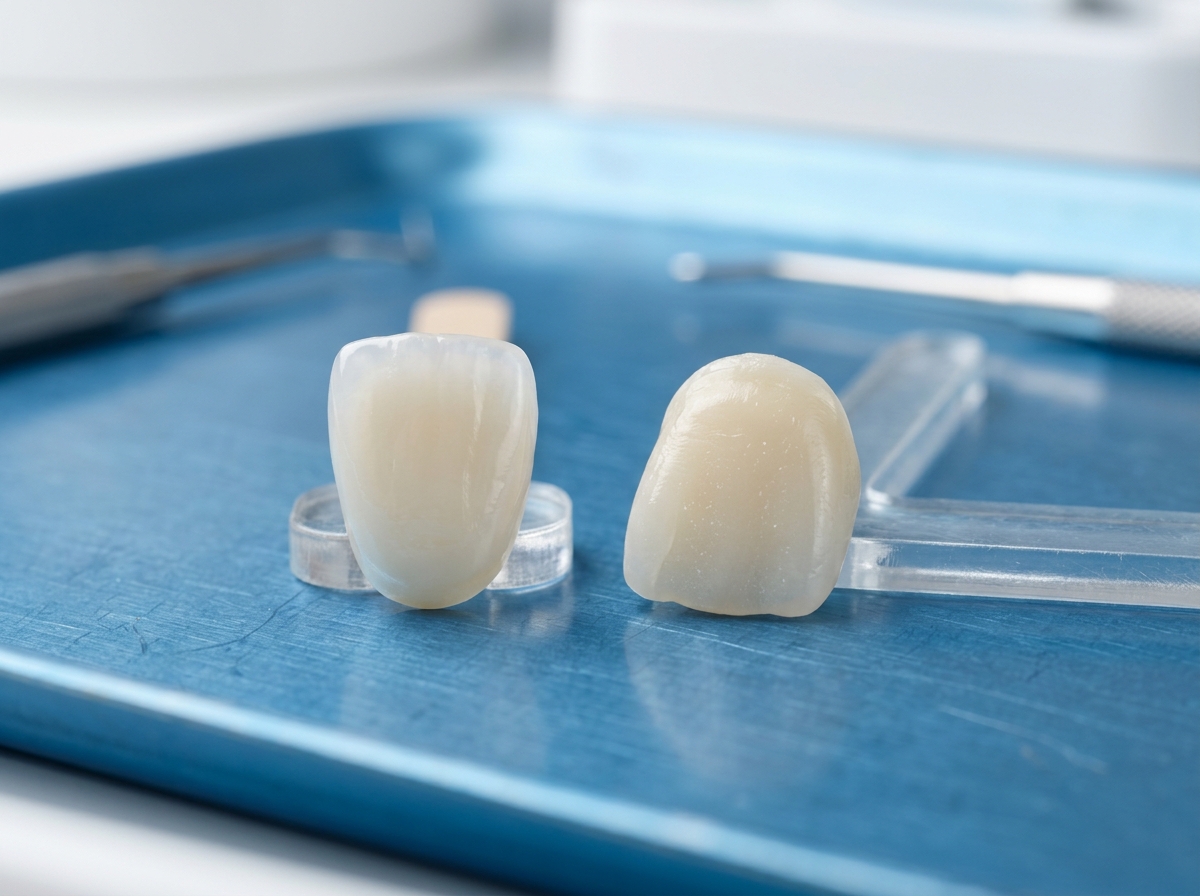
How Do Stain Resistance and Surface Gloss Compare Over 15 Years?
Featured Snippet Summary: Non-porous Emax lithium disilicate ceramic is highly stain-resistant to coffee and tea over many years under proper oral hygiene, whereas composite resin matrices contain organic polymers that absorb micro-pigments and lose surface polish within 3 to 5 years.
The long-term aesthetic appearance of a cosmetic restoration depends directly on its physical surface porosity. Restorative dental specialists evaluate key material differences over time:
Why Does Composite Resin Discolor Faster Than Glazed Porcelain?
Prosthodontic researchers highlight three primary surface degradation factors in direct resin restorations:
- Organic Polymer Matrix Water Absorption: Composite resins contain bis-GMA monomer matrices that absorb dietary liquids, leading to marginal darkening and surface dullness after several years of daily use.
- Glazed Ceramic Surface Density: High-temperature vacuum firing seals Emax disilicate porcelain, making it resistant to coffee, red wine, or tobacco micro-pigment penetration for many years.
- Gloss Retention and Polish Stability: While composite resin requires periodic repolishing to maintain luster, glazed Emax porcelain retains its natural enamel translucency and glossy sheen over decades. Learn about smile design in our smile makeover services guide.
How Does Micro-Structure Impact Plaque Accumulation?
The smooth glass-ceramic surface of Emax disilicate repels bacterial plaque biofilm more effectively than composite resin, supporting healthiest gingival tissue response around restoration margins. Read our emax porcelain crowns guide for full-coverage ceramic options.
What Is the Flexural Strength Difference: Emax (500 MPa) vs Resin (120 MPa)?
Mechanical Benchmark: Swiss Emax Press lithium disilicate delivers 400 to 500 MPa flexural strength and high chip resistance, compared to 100 to 140 MPa for direct composite resin bonding.
Masticatory biting forces in the anterior incisor region impose significant flexural stress on dental restorations. Mechanical testing in dental material science confirms clear performance gaps:
How Do Flexural Strength and Fracture Resistance Impact Long-Term Function?
- Emax Press Lithium Disilicate (400-500 MPa): Fused glass-ceramic crystals absorb heavy biting loads without cracking, making Emax ideal for lengthening worn incisal edges or closing gaps.
- Direct Composite Resin (100-140 MPa): Methacrylate resin matrix filled with micro-silica particles provides moderate initial strength but is susceptible to incisal edge chipping under heavy biting forces.
- Chipping Repairability vs Longevity: Chipped composite bonding can be patched directly in the clinic in one visit, whereas fractured porcelain requires replacement but occurs with far lower frequency. Read about whitening combinations in our laser teeth whitening services page.
What Is the Reversibility Difference Between Composite Bonding and Emax Veneers?
Ethical Clinical Notice: Direct composite bonding is generally a reversible procedure requiring minimal to no tooth alteration, whereas Emax porcelain veneers involve irreversible micro-enamel preparation, permanently requiring ceramic coverage to maintain surface protection.
What Is the 10-Year Financial Cost Breakdown and Replacement Frequency?
Financial Insight: While direct composite bonding costs less upfront, requiring replacement or repolishing every 4 to 6 years makes Emax porcelain veneers (lasting 15 to 20 years) a more cost-effective choice over a 10-to-15-year period.
Evaluating financial value requires considering both initial treatment costs and long-term maintenance requirements. Clinical teams analyze total expenditure based on typical replacement intervals reported in prosthetic surveys:
How Does Replacement Frequency Affect Total Investment Over 10 Years?
- Direct Composite Bonding Timeline: Lower initial cost per tooth ($180 AUD at Dental NKT), but typically requires professional repolishing every 2 years and full replacement 2 to 3 times over a decade based on clinical survey benchmarks.
- Emax Porcelain Veneers Timeline: Higher initial investment per tooth ($520 AUD at Dental NKT), but maintains color stability and structural integrity over 15 to 20+ years under routine 6-month hygiene checkups.
- Long-Term Value Conclusion: Over a 10-year horizon, Emax porcelain veneers offer lower cumulative cost and superior aesthetic consistency compared to multiple composite repairs. Learn more in our emax vs zirconia veneers comparison guide.
How Do Emax Veneers and Composite Bonding Costs Compare Between Australia and Vietnam?
Ultra-thin Emax porcelain veneers cost $520 AUD per tooth at Dental NKT compared to $1,200 - $2,500 AUD in Australia, while composite bonding costs $180 AUD per tooth compared to $400 - $800 AUD in Australia.
Note: Australian fee estimates are based on published Australian Dental Association (ADA) average fee survey benchmarks for composite resin (ADA item 522) and porcelain veneers (ADA item 582). Dental NKT fees reflect all-inclusive clinical service pricing in Hanoi.
| Restoration Type & Material | Flexural Strength & Expected Lifespan | Cost in Australia (AUD) | Dental NKT Price (AUD) |
|---|---|---|---|
| Emax Press Lithium Disilicate Veneer | 400-500 MPa strength, non-porous stain resistance, 15-20 year lifespan | $1,200 - $2,500 AUD | $520 AUD (Save 70 percent) |
| Master Hand-Layered Emax Porcelain | 500 MPa strength, custom opal incisal layering by ceramist, 15-20 year lifespan | $1,800 - $2,800 AUD | $650 AUD (Save 72 percent) |
| Direct Micro-Hybrid Composite Bonding | 100-140 MPa strength, chairside resin placement, 4-6 year lifespan | $400 - $800 AUD | $180 AUD (Save 75 percent) |
Details: 500 MPa Flexural Strength + Non-Porous Ceramic
Sydney Price: $1,200 - $2,500 AUD
Details: Custom Opal Incisal Layering by Master Ceramist
Sydney Price: $1,800 - $2,800 AUD
Details: Chairside Resin Sculpting (120 MPa Strength)
Sydney Price: $400 - $800 AUD
Why Choose Hanoi and Dental NKT for Aesthetic Porcelain Restorations?
International patients traveling to Hanoi receive full travel concierge assistance, 3D Digital Smile Design simulations, and 10-year global warranty passports.
Choosing Dental NKT in Hanoi allows international travelers to receive premium Swiss Emax restorations while saving up to 70 percent compared to Australian private clinic fees. Review our global warranty terms for complete details.
- Digital Smile Design (DSD): Preview your customized smile simulation on 3D software prior to tooth preparation.
- 10-Year Global Warranty: Backed by official Emax manufacturer certificates for international maintenance support.
- Transparent Billing: Zero hidden fees, covering 3D scans, mock-up try-ins, temporary veneers, final Emax disilicate bonding, and private airport transfers. Explore our dentists and clinical team profile page. Feel free to contact our clinical team to schedule your evaluation.
Clinical Care Notice: Restorative Material Assessment
Schedule Your Cosmetic Restoration Consultation
Receive a free 3D Digital Smile Design evaluation and material durability review prior to traveling to Hanoi.
Schedule a Pre-Travel Clinical ReviewFAQ: How Long Do Emax Porcelain Veneers Last Compared to Composite?
Q1: How long do Emax porcelain veneers last compared to composite bonding?
Emax porcelain veneers typically last 15 to 20+ years with proper oral hygiene, whereas composite bonding generally requires repolishing or replacement every 4 to 6 years.
Q2: Can chipped composite bonding be repaired easily?
Yes, minor chips in composite resin can be repaired directly in a single chairside appointment by adding fresh composite material.
Q3: Which material is better for closing gaps between front teeth?
While composite bonding can close small gaps quickly, Emax porcelain veneers offer superior long-term stain resistance and mechanical strength for larger diastema closures.