Patients with deep grey or dark brown intrinsic tooth discoloration from childhood antibiotic exposure often experience frustration with standard whitening products. When evaluating restorative solutions, understanding how porcelain veneers for tetracycline stained teeth, multi-opal layering techniques, and precise shade selection overcome severe staining allows you to regain a brilliant, natural smile. For zero-prep candidacy details, review our no prep vs traditional veneers comparison guide.
Biomimetic dental research published by Magne et al. demonstrates that severe Grade 3 and Grade 4 tetracycline discoloration requires customized opalescent dentin liners to block dark underlying hues while preserving superficial translucency. At Dental NKT, Dr. Nguyen Thu Hoai applies advanced multi-layer ceramic stratification and Swiss-milled Ivoclar Emax lithium disilicate to mask dark dentin bands without aggressive tooth grinding. Explore our specialized porcelain veneers service guide page for all aesthetic options.
In this clinical guide, Dr. Nguyen Thu Hoai, Senior Cosmetic Prosthodontist at Dental NKT, explains why chemical teeth whitening fails on deep antibiotic stains, the mechanics of multi-opal dentin masking, selecting natural shade spectrums (BL3 / A1), and transparent pricing for international patients in Hanoi. Check our Dental NKT International Pricing Directory for all-inclusive treatment fees.
Why Does Chemical Teeth Whitening Fail on Deep Antibiotic Staining?
Featured Snippet Summary: Tetracycline antibiotics chelate with calcium ions during childhood dentin formation, depositing permanent dark horizontal bands deep within mineralized dentin that cannot be oxidized by hydrogen peroxide gels.
Many patients attempt multiple rounds of high-concentration professional bleaching without success. Restorative dental specialists evaluate the biochemical obstacles of tetracycline staining:
What Biochemical Factors Prevent Peroxide Oxidation in Dentin?
Cosmetic dentistry researchers highlight three primary reasons why chemical whitening is ineffective for antibiotic discoloration:
- Chelation with Dentin Calcium: Tetracycline molecules incorporate permanently into the hydroxyapatite crystal structure of dentin during odontogenesis, creating deep intrinsic discoloration.
- Superficial Enamel Penetration: Hydrogen and carbamide peroxide gels only oxidize organic chromophores within superficial enamel prisms, failing to reach the deeply bound dark dentin matrix. Read about whitening limits in our laser teeth whitening services guide.
- Horizontal Dark Staining Bands: Severe Grade 3 and Grade 4 tetracycline staining manifests as distinct dark grey, purple, or dark brown horizontal stripes across the middle and cervical thirds of the tooth crown.
How Do Staining Severity Grades (Grade 1 to 4) Influence Restorative Selection?
Clinical Classification: Grade 1-2 mild discoloration is ideal for standard minimal-prep veneers, Grade 3 requires opalescent liners, while Grade 4 severe black banding requires individual evaluation to determine whether veneers or full crowns offer optimal masking density.
Applying the Jordan and Boksman classification system helps cosmetic specialists select the appropriate restoration type based on staining intensity:
When Are Full Crowns Recommended Over Thin Porcelain Veneers?
- Grade 1 & 2 (Light Yellow / Uniform Grey): Responds excellently to 0.3mm minimal-prep Emax veneers without specialized opaque liners.
- Grade 3 (Moderate Dark Grey / Purple Banding): Successfully masked using 0.3mm to 0.5mm micro-prep combined with opalescent dentin liners.
- Grade 4 (Severe Black / Dark Brown Banding): Requires careful clinical evaluation. Extremely sallow dentin may show through ultra-thin ceramic, making full-coverage Emax disilicate crowns a superior choice to achieve complete opacity. Learn about full coverage in our emax porcelain crowns guide.
How Does Multi-Opal Layering Mask Dark Dentin Without Deep Grinding?
Biomimetic Masking Technique: Applying a 0.1mm micro-opalescent ceramic liner diffuses dark dentin reflections, allowing master ceramists to mask severe discoloration with minimal 0.3mm to 0.5mm enamel preparation.
Historically, treating tetracycline-stained teeth required aggressive full-coverage crowns. Modern adhesive biomimetic principles established by Magne et al. provide conservative alternative solutions:
How Do Opalescent Liners Neutralize Dark Sub-Surfaces?
- Opalescent Dentin Masking: A specialized 0.1mm opaque-white or light-yellow ceramic liner is applied directly over prepared enamel to block dark grey dentin shine-through.
- Micro-Stratification of Ceramic Layers: Master ceramists build up Emax Press lithium disilicate porcelain in thin, progressive layers, combining opalescent cores with translucent incisal enamel.
- Material Comparison vs Composite Resin: Emax disilicate provides superior stain-masking density and flexural strength compared to direct resin bonding. Read our emax veneers vs composite bonding durability guide for material comparisons.
What Is the Informed Consent Notice Regarding Preparation Depth and Optical Refraction?
Ethical Aesthetic Disclosure: Preparation Depth and Optical Limits. Masking dark Grade 3/4 tetracycline bands requires 0.3mm to 0.5mm micro-enamel preparation. Under intense directional lighting or specific angles, micro-reflections from extremely sallow underlying dentin bands may subtly show through translucent ceramic boundaries.
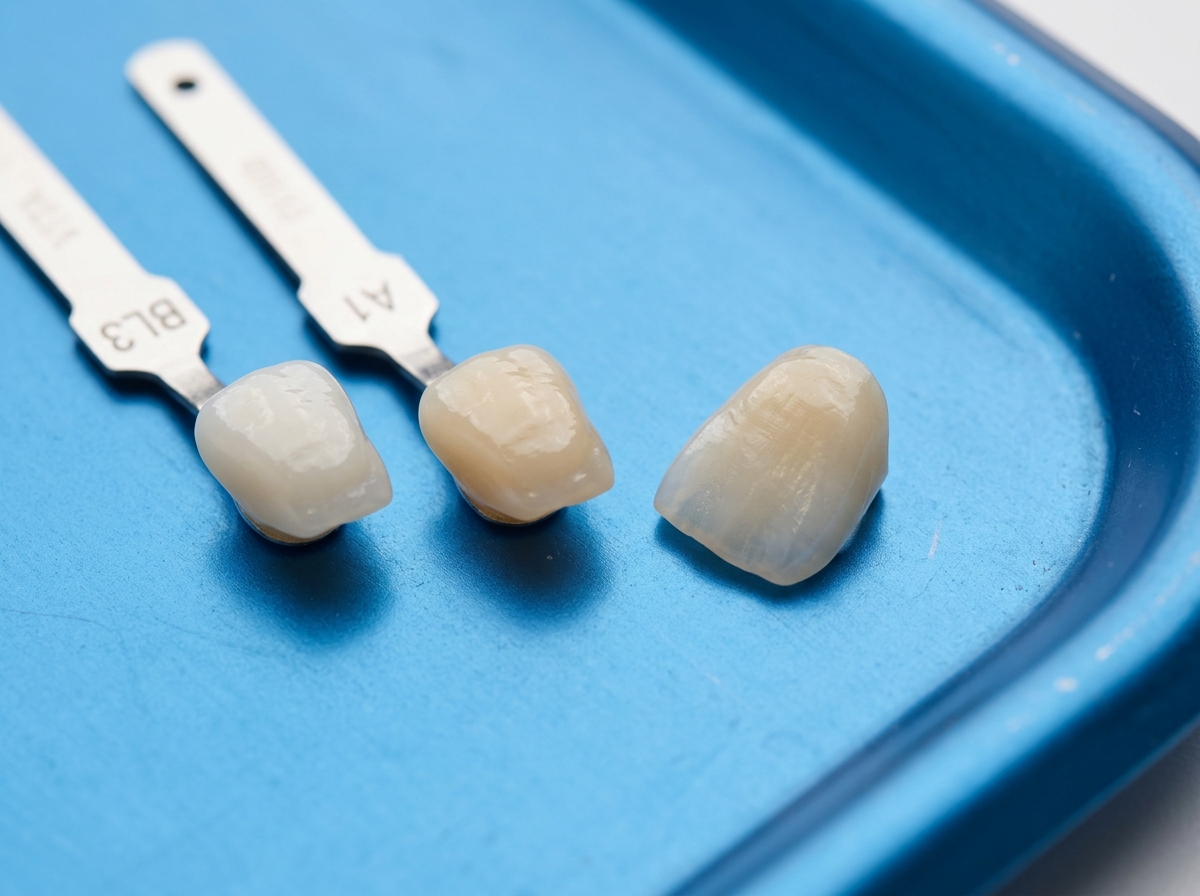
How Do You Select Natural Translucency Shades (BL3 / A1) to Prevent Chalky Appearance?
Shade Selection Benchmark: Choosing Bleach 3 (BL3) or Natural A1 shades with graduated incisal translucency creates a brilliant, natural smile without looking opaque or chalky.
One common concern when masking dark teeth is ending up with monochromatic, artificial-looking white crowns. Cosmetic specialists utilize advanced digital color matching:
What Shade Design Guidelines Create Lifelike Results?
- Bleach 3 (BL3) Soft Brightness: Provides a luminous white shade that reflects light naturally while remaining softer than harsh BL1 or BL2 ultra-white shades.
- Natural A1 Enamel Match: Ideal for patients seeking a warm, sophisticated natural tooth tone that perfectly complements skin complexion.
- Incisal Translucency Effect: Layering transparent ceramic at the incisal edge mimics natural light transmission, avoiding a flat, chalky appearance. Learn about smile proportions in our veneers for gapped teeth guide.
How Do Porcelain Veneer Costs for Tetracycline Stained Teeth Compare Between Australia and Vietnam?
Specialized Emax disilicate porcelain veneers for tetracycline masking cost $520 to $650 AUD per tooth at Dental NKT, compared to $1,200 - $2,500 AUD per tooth in Australia.
Note: Australian fee estimates are based on published Australian Dental Association (ADA) average fee survey benchmarks for cosmetic porcelain veneers (ADA item 582 & 583). Dental NKT fees reflect all-inclusive clinical service pricing in Hanoi.
| Porcelain Veneer Masking Package | Preparation Depth & Ceramic Layering | Cost in Australia (AUD) | Dental NKT Price (AUD) |
|---|---|---|---|
| Emax CAD Opalescent Masking Veneer | 0.3-0.5mm micro-prep, 0.1mm opaque liner, Emax disilicate | $1,200 - $1,800 AUD | $520 AUD (Save 65 percent) |
| Master Hand-Layered Tetracycline Package | Multi-opal layering by master ceramist, BL3/A1 custom shade match | $1,800 - $2,500 AUD | $650 AUD (Save 70 percent) |
| Full Smile Makeover (8 to 10 Teeth) | Complete arch mask, 3D Digital Smile Design, 10-year global warranty | $12,000 - $18,000 AUD | $4,160 AUD (Save 70 percent) |
Details: 0.3-0.5mm Micro-Prep + 0.1mm Opalescent Liner
Sydney Price: $1,200 - $1,800 AUD
Details: Multi-Opal Layering + Custom BL3/A1 Shade
Sydney Price: $1,800 - $2,500 AUD
Details: 8 Emax Disilicate Veneers + 3D Digital Smile Design
Sydney Price: $12,000 - $18,000 AUD
Why Choose Hanoi and Dental NKT for Masking Severe Tooth Discoloration?
International patients traveling to Hanoi receive full travel concierge assistance, 3D Digital Smile Design simulations, and 10-year global warranty passports.
Choosing Dental NKT in Hanoi allows international travelers to mask severe tetracycline staining in 5 days while saving up to 70 percent compared to Australian private clinic fees. Explore our full range of smile makeover services or read about full-coverage emax porcelain crowns. Review our global warranty terms for complete details.
- Digital Smile Design (DSD): Preview your customized shade mask simulation on 3D software prior to tooth preparation.
- 10-Year Global Warranty: Backed by official Emax manufacturer certificates for international maintenance support.
- Transparent Billing: Zero hidden fees, covering 3D scans, mock-up try-ins, temporary veneers, final Emax disilicate bonding, and private airport transfers. Explore our dentists and clinical team profile page. Feel free to contact our clinical team to schedule your evaluation.
Clinical Care Notice: Tetracycline Staining Assessment
Schedule Your Antibiotic Discoloration Consultation
Receive a free 3D Digital Smile Design evaluation and dentin masking review prior to traveling to Hanoi.
Schedule a Pre-Travel Clinical ReviewFAQ: Can Porcelain Veneers Cover Dark Grey Tetracycline Stains?
Q1: Can porcelain veneers cover dark grey tetracycline stains?
In most clinical cases with appropriate case selection, porcelain veneers using opalescent dentin liners successfully mask moderate to severe tetracycline discoloration, though extreme Grade 4 cases may benefit from full crowns.
Q2: Is tooth grinding necessary for tetracycline stained teeth?
Severe Grade 3/4 tetracycline staining generally requires 0.3mm to 0.5mm micro-enamel preparation to accommodate opaque dentin liners without creating bulky teeth.
Q3: Will masked veneers look chalky or artificial?
By selecting natural Bleach 3 (BL3) or A1 shades with hand-layered translucent incisal ceramic, restorations achieve a radiant, natural luster without a chalky appearance.