Patients who have completed titanium tooth restoration often ask how to maintain their prosthesis to ensure it lasts a lifetime. When establishing long-term oral care habits, understanding the single dental implant routine maintenance cleaning, specialized carbon fiber scaling protocols, and annual bone crest monitoring allows you to protect your investment and prevent peri-implant inflammation. For initial treatment cost breakdowns, review our single dental implant cost guide.
Clinical studies in implant maintenance published in international periodontology journals confirm that professional hygiene visits every 6 months significantly reduce the risk of mucositis and bone loss around titanium fixtures. At Dental NKT, Dr. Nguyen Huy Hoang utilizes non-scratch carbon fiber scalers, glycine powder air-polishing, and digital torque auditing during routine maintenance checkups. Explore our comprehensive dental implant services page for complete post-operative care options.
In this clinical guide, Dr. Nguyen Huy Hoang, Head of Implantology & Oral Surgery at Dental NKT, details why traditional metallic scalers damage titanium surfaces, how screw torque tightness and bite alignment are evaluated, and the importance of annual digital radiographs for international patients in Hanoi. Check our Dental NKT International Pricing Directory for transparent treatment fees.
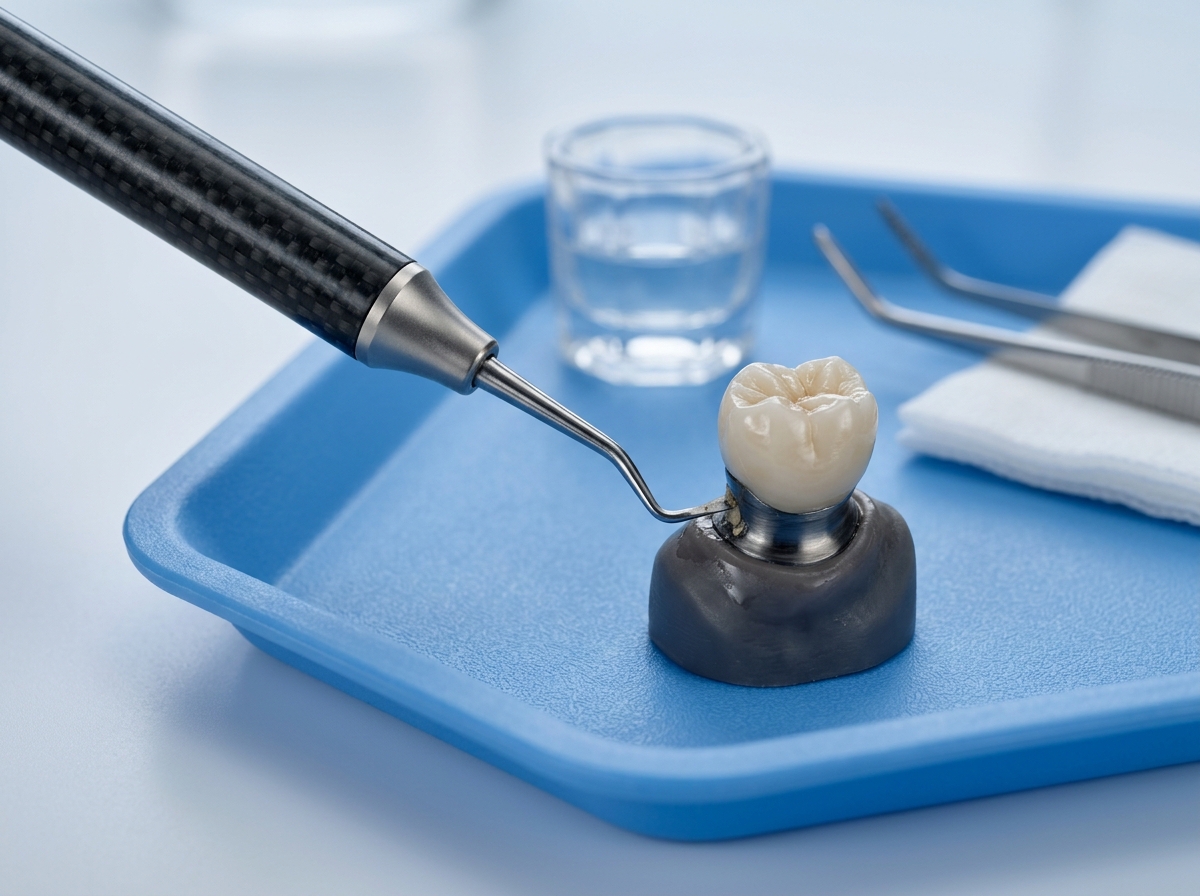
Why Do Metallic Scalers Scratch Titanium Implants?
Featured Snippet Summary: Standard stainless steel hygiene scalers are harder than Grade 4 or Grade 5 titanium, creating microscopic scratches on abutment surfaces that harbour peri-implant bacterial biofilm.
Cleaning a titanium implant requires specialized hygiene instrumentation that differs from natural tooth scaling. Clinical maintenance protocols focus on gentle debridement:
What Materials Are Used for Safe Implant Debridement?
Prosthodontic specialists utilize specific non-abrasive tools during 6-month hygiene visits:
- Carbon Fiber & PEEK Scalers: High-tech carbon fiber or polyether ether ketone (PEEK) instruments remove calculus deposits without scratching polished titanium abutment collars.
- Glycine Powder Air-Polishing: Fine sub-gingival glycine or erythritol powder streams clean microscopic implant threads safely without altering surface roughness.
- Avoidance of Stainless Steel Instruments: Conventional metal hygiene instruments leave micro-grooves on titanium, encouraging rapid bacterial plaque re-colonization. Learn about peri-implantitis prevention in our laser peri implantitis treatment guide.
How Does Professional Cleaning Prevent Peri-Implant Mucositis?
Removing sub-gingival biofilm every 6 months prevents soft tissue inflammation (mucositis) from progressing into irreversible crestal bone loss (peri-implantitis). Read our 3d guided single implant surgery guide for structural positioning details.
How Are Screw Torque Tightness and Occlusal Alignment Checked?
Clinical Checkpoint: Checking prosthetic screw torque tightness and verifying occlusal contacts ensures that biting forces remain axially distributed without causing micro-motion or porcelain chipping.
Implant crowns are subject to continuous mechanical biting forces over time. Clinical specialists perform systematic structural audits during routine recall appointments:
What Mechanical Factors Are Verified During Maintenance?
- Abutment Screw Torque Audit: Using a calibrated digital torque wrench, specialists verify that internal prosthetic screws maintain their recommended manufacturer torque (typically 25 to 35 Ncm).
- Articulating Paper Occlusal Analysis: Thin articulating paper checks bite contact points to ensure heavy biting forces are directed down the long axis of the implant post rather than laterally.
- Zirconia Crown Integrity Inspection: High-magnification loupes inspect porcelain margins for early signs of micro-wear, micro-fractures, or food impaction gaps. Read our Straumann vs Nobel Biocare single implant comparison for crown attachment options.
Why Are Annual Digital Radiographs Essential for Monitoring Bone Crests?
Diagnostic Standard: Low-dose annual digital periapical X-rays monitor marginal bone crest levels, ensuring that bone loss remains under 0.2mm per year after the first year of function.
Sub-gingival bone level changes cannot be detected by visual inspection alone. Dental specialists utilize low-dose digital radiography to track biological stability:
What Diagnostic Benchmarks Are Tracked Over Time?
- Marginal Bone Crest Height: Comparing annual intraoral periapical radiographs against baseline post-surgery X-rays verifies stable bone contact at the first implant thread.
- Interproximal Papilla Height: Radiographs confirm that surrounding alveolar bone supports natural gum papillae, preventing black triangle gaps.
- Osstell ISQ Resonance Frequency Verification: If screw tightening or restorative work is required, magnetic Osstell ISQ stability testing confirms bone stability scores remain above ISQ 70. Learn more in our single implant bone graft cost timeline guide.
How Do Dental Implant Maintenance Costs Compare Between Australia and Vietnam?
Professional implant hygiene and maintenance checkups range from $120 to $250 AUD at Dental NKT, compared to $250 - $700 AUD for equivalent specialist recall visits in Australia.
Note: Maintenance service packages are tailored during your clinical checkup based on individual hygiene needs and radiographic findings.
| Maintenance Service Tier | Included Hygiene & Diagnostic Procedures | Cost in Australia (AUD) | Dental NKT Price (AUD) |
|---|---|---|---|
| 6-Month Hygiene & Air Polishing Package | Carbon fiber scaling + Sub-gingival glycine air-polishing + Gum probing check | $250 - $350 AUD | $120 AUD (Save 65 percent) |
| Occlusal Alignment & Torque Tightness Audit | Carbon fiber cleaning + Digital screw torque verification + Articulating paper bite check | $350 - $500 AUD | $180 AUD (Save 64 percent) |
| Annual 3D CBCT Bone Crest & Torque Audit | Full hygiene polish + Digital radiographs + 3D bone crest analysis + Global passport check | $500 - $700 AUD | $250 AUD (Save 64 percent) |
Details: Carbon Fiber Scaling + Glycine Air Polishing
Sydney Price: $250 - $350 AUD
Details: Carbon Fiber Cleaning + Screw Torque & Bite Check
Sydney Price: $350 - $500 AUD
Details: Hygiene Polish + Digital X-Rays + 3D Bone Analysis
Sydney Price: $500 - $700 AUD
Why Choose Hanoi and Dental NKT for Long-Term Implant Maintenance?
International patients traveling to Hanoi enjoy routine maintenance checkups performed by senior implantologists, lifetime warranty support, and complete digital documentation.
Choosing Dental NKT in Hanoi provides international patients with continuous long-term care and total confidence. Review our global warranty terms for complete details.
- Dedicated Travel Concierge: Private airport transfers and boutique hotel booking within 5 minutes of our clinic.
- Lifetime Global Warranty: Backed by official manufacturer implant passports for worldwide maintenance coverage.
- Transparent Billing: Zero hidden fees, including 3D CBCT imaging, carbon fiber scaling, and digital torque checks. Explore our dentists and clinical team profile page. Feel free to contact our clinical team to schedule your evaluation.
Clinical Care Notice: Routine Hygiene & Maintenance Check
Schedule Your Dental Implant Maintenance Checkup
Receive a professional carbon fiber hygiene cleaning and digital bone crest audit prior to traveling or during your visit to Hanoi.
Schedule a Pre-Travel Clinical ReviewFAQ: How Often Should Dental Implants Be Professionally Cleaned?
Q1: How often should dental implants be professionally cleaned?
Dental implants should be professionally cleaned every 6 months using non-scratch carbon fiber scalers and sub-gingival glycine air-polishing.
Q2: Can I get my implant cleaned by a local dentist in Australia?
Yes, routine 6-month cleaning can be performed by any licensed Australian dental hygienist using carbon fiber or plastic scalers, as recorded in your official implant passport.
Q3: What happens if an implant screw becomes slightly loose over time?
If a prosthetic screw loosens, a dentist simply unseals the access hole, retorques the screw to manufacturer specifications (25-35 Ncm), and reseals the opening in a 15-minute visit.