Patients missing two or three consecutive teeth often face a critical dilemma when choosing between a traditional tooth-supported dental bridge and a modern implant-supported bridge. When evaluating your restorative options, analyzing the implant supported bridge vs traditional bridge cost, structural durability, and long-term biological impact helps you make an informed decision for your smile. For single gap restoration details, explore our single dental implant cost guide.
While traditional bridges have been utilized for decades, they require grinding down healthy adjacent teeth to serve as anchor abutments. Conversely, implant-supported bridges rely entirely on titanium posts inserted directly into the jawbone, protecting 100 percent of your natural tooth structure. Review our full range of dental implant services page for all available gap solutions.
In this clinical comparison, Dr. Nguyen Thu Hoai, Aesthetic Restoration Specialist at Dental NKT, breaks down the 15-year financial value, enamel preservation rates, and structural longevity of both restorative solutions for international patients. Check our Dental NKT International Pricing Directory for transparent treatment packages.
What Is the Hidden Risk of Traditional Tooth-Supported Bridges?
Featured Snippet Summary: Traditional bridges require removing 40 to 60 percent of healthy enamel from adjacent abutment teeth. Over a 10-year period, up to 30 percent of these anchor teeth suffer nerve necrosis or recurrent decay underneath the bridge crown.
A traditional dental bridge relies on natural teeth bordering the missing gap to support a central prosthetic tooth (pontic). To fit the supporting crowns, Dr. Nguyen Thu Hoai explains that healthy natural enamel must be permanently shaved down.
How Does Enamel Removal Compromise Adjacent Anchor Teeth?
Grinding down healthy tooth structure exposes dentin tubules and increases susceptibility to bacterial invasion:
- Irreversible Structural Loss: Once natural enamel is removed, the anchor teeth will permanently require protective crowns for life.
- Increased Root Canal Risk: Deep tooth preparation can traumatize the dental pulp, causing nerve inflammation that necessitates endodontic therapy.
- Recurrent Decay Margin: Plaque accumulation at the gum margin of traditional bridge crowns remains a leading cause of bridge failure.
Why Do Implant Bridges Protect Neighboring Natural Teeth?
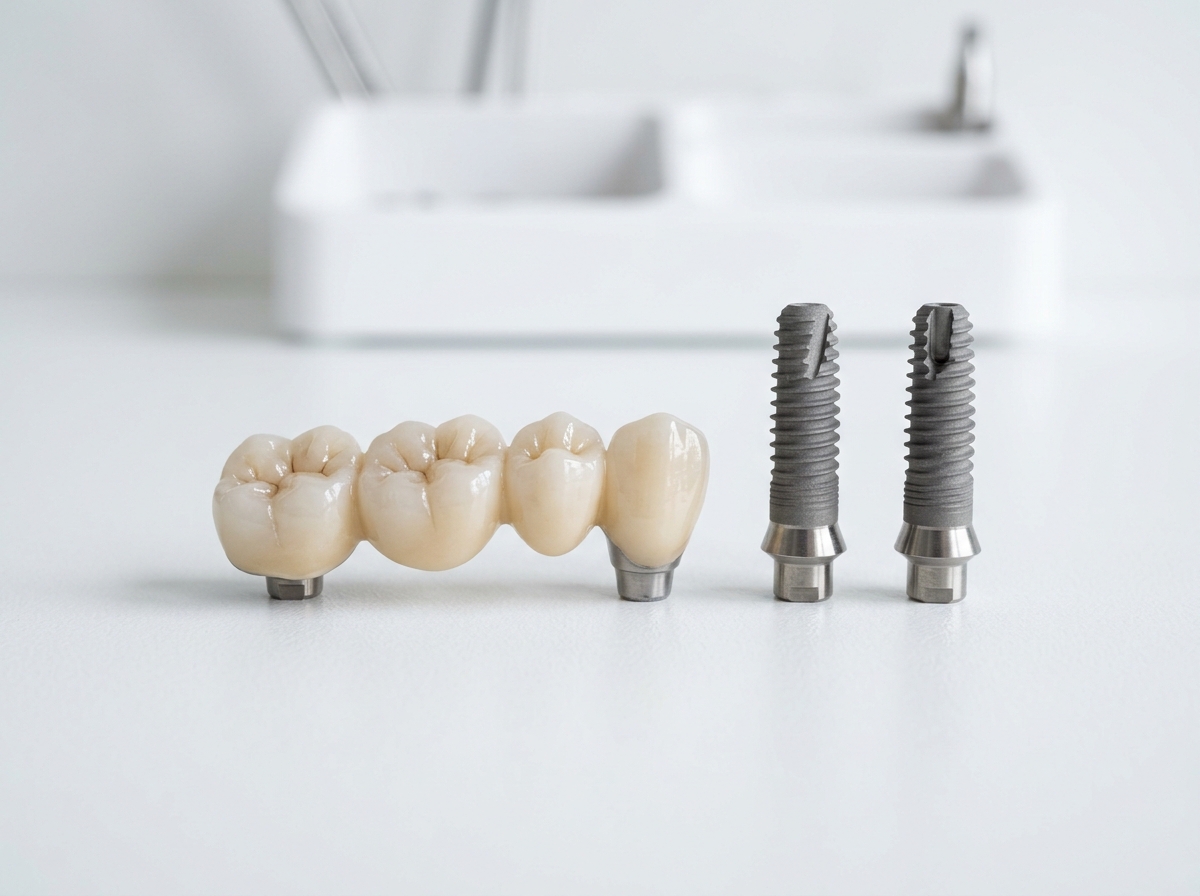
Implant-supported bridges eliminate adjacent tooth preparation entirely. Two titanium implant posts serve as independent anchor roots, leaving neighboring natural teeth completely untouched. Read our multiple dental implants procedure guide for structural gap restoration details.
How Do Implant Bridges Prevent Long-Term Jawbone Resorption?
Titanium implants provide functional chewing stimulation directly to alveolar bone cells, halting bone loss. Traditional bridges sit on top of the gums, allowing underlying bone height to shrink by up to 25 percent in the first year.
Jawbone density requires direct mechanical stimulation from natural tooth roots or titanium implant posts to maintain its volume. When a tooth is lost, the surrounding bone quickly begins to resorb.
What Causes Bone Loss Beneath Traditional Bridge Pontics?
Because a traditional bridge pontic simply hovers over the gum tissue without extending into the jawbone, zero chewing force is transmitted to the bone underneath. Consequently, the bone beneath the missing gap continues to shrink over time, creating an unsightly gap beneath the bridge where food particles lodge.
How Does Osseointegration Maintain Facial Structure and Gum Line?
Titanium implant posts undergo osseointegration, fusing directly with surrounding bone cells. This stimulation preserves natural bone height, supports facial contours, and prevents the sunken facial collapse associated with long-term tooth loss. Learn more on our advanced technology and equipment page.
15-Year Value Comparison: What Are the Real Maintenance and Replacement Costs?
While a traditional bridge has a lower initial price, its average lifespan is 7 to 10 years, requiring costly replacements. An implant-supported bridge offers a 98 percent 15-year survival rate, proving far more economical over time.
| Clinical & Financial Criteria | Traditional Tooth-Supported Bridge | Implant-Supported Zirconia Bridge |
|---|---|---|
| Impact on Adjacent Teeth | Requires 50 percent enamel reduction | Zero enamel reduction (100 percent intact) |
| Jawbone Density Preservation | Progressive bone resorption under gap | Halts bone loss via osseointegration |
| Average Clinical Lifespan | 7 to 10 Years (Requires replacement) | 20+ Years / Lifetime (Global Warranty) |
| Initial Cost in Sydney / Melbourne | $4,500 - $6,000 AUD | $11,000 - $14,000 AUD |
| Dental NKT Package Price | $1,200 AUD | $3,100 AUD (Save 75 percent vs AU) |
Adjacent Teeth: Zero enamel reduction
Bone Preservation: Halts jawbone loss
Average Lifespan: 20+ Years / Lifetime
Sydney Price: $11,000 - $14,000 AUD
Adjacent Teeth: Shaves 50 percent enamel
Bone Preservation: Progressive resorption
Average Lifespan: 7 to 10 Years
Sydney Price: $4,500 - $6,000 AUD
Why Choose Hanoi and Dental NKT for Your Implant Bridge Treatment?
Every patient receives an official Medical Implant Passport with serial number QR verification, lifetime global warranty protection, and itemized English invoices for health insurance reimbursement.
When replacing failing traditional bridges at Dental NKT in Hanoi, international patients receive comprehensive biological restoration performed by experienced specialists. Review our global warranty terms for complete details.
- Serial Number Verification: Each Straumann and Nobel fixture features a unique QR code registered on the manufacturer’s global portal.
- Lifetime Global Warranty: If any mechanical adjustment is needed in Australia, your restoration is backed by global warranty coverage.
- Transparent Packages: Our $3,100 AUD 3-unit bridge package includes 2 titanium posts, custom abutments, and a monolithic Zirconia bridge with zero hidden fees. Read our Straumann vs Nobel Biocare comparison for fixture specifications. Feel free to contact our clinical team to plan your consultation.
Ready to upgrade your failing traditional bridge to a permanent implant bridge in Hanoi? Contact our clinical team to receive a personalized digital treatment plan today.
Book Free Digital AssessmentFAQ: How Many Years Does an Implant-Supported Bridge Last Compared to a Traditional Bridge?
Q1: How many years does an implant-supported bridge last compared to a traditional bridge?
Implant-supported bridges demonstrate a 15-year survival rate exceeding 98 percent and frequently last a lifetime with proper oral hygiene. In contrast, traditional tooth-supported bridges average a 7 to 10 year lifespan before requiring replacement due to decay or anchor tooth failure.
Q2: Can a failing traditional bridge be replaced with an implant-supported bridge?
Yes, failing traditional bridges are frequently replaced with implant-supported bridges. If the underlying anchor teeth are decayed, they are extracted, and titanium implants are placed in optimal biological positions after 3D CBCT evaluation.
Q3: How long does the treatment process take for an implant bridge in Hanoi?
Standard treatment involves two visits to Hanoi. Visit 1 requires 3 days for implant placement and temporary bridge fitting. Visit 2 requires 3 to 5 days after 3 months of osseointegration for final monolithic Zirconia bridge installation. Read our dentists and clinical specialists page for specialist credentials.