The Major Benefits: Why Do Australians Choose All-on-4?
The primary benefits of All-on-4 implants are rapid restoration of chewing function, lower overall treatment costs, and avoiding extensive bone grafts by placing the implants at an angle.
For many Australians suffering from advanced tooth decay, severe periodontal disease, or failing teeth, the search for a permanent solution leads directly to full arch restoration options. When weighing the options, evaluating a detailed list of all on 4 dental implants pros and cons is essential. Developed by Nobel Biocare, this protocol uses just four implants to secure a full arch prosthesis, offering a life-changing alternative to loose dentures.
One of the chief reasons this treatment has gained global popularity is its biomechanical efficiency. By tilting the two posterior implants at an angle, surgeons can maximize contact with the densest bone in the anterior jaw. This design not only provides solid structural support but also drastically reduces the need for bone grafting, saving months of healing time and thousands of dollars in surgical fees.
To help you understand why this procedure has become a cornerstone of modern reconstructive dentistry, we have compiled the key advantages below:
- Reduced Surgical Sites: Placing only four titanium fixtures minimizes surgical trauma and postoperative swelling.
- No Complex Grafting: Avoids the need for maxillary sinus lifts or painful block grafts in most clinical scenarios.
- Stable Restoration: Unlike traditional dentures, the bridge is fixed, meaning no slipping, clicking, or embarrassing speech issues.
- Preservation of Jaw Structure: The implants stimulate the jawbone, preventing the facial collapse and bone loss associated with toothless jaws.
Are All-on-4 Implants Cost-Effective with Immediate Function?
For patients traveling from Australia for dental holiday safety, time and budget efficiency are critical parameters. The All-on-4 concept allows for the placement of a temporary fixed bridge within 24 to 72 hours of surgery. This means you do not have to spend months without teeth while your bone integrates with the titanium posts.
Financially, the cost savings are substantial. Because fewer implants are required and complex bone grafts are avoided, the overall cost is significantly lower than traditional full-mouth implant configurations (which require 8 to 10 implants per arch). For Australians choosing to undergo treatment in Hanoi, the savings exceed 65% compared to private clinics in Sydney or Melbourne. You can review our transparent rates on our dental implant price list to help plan your budget.
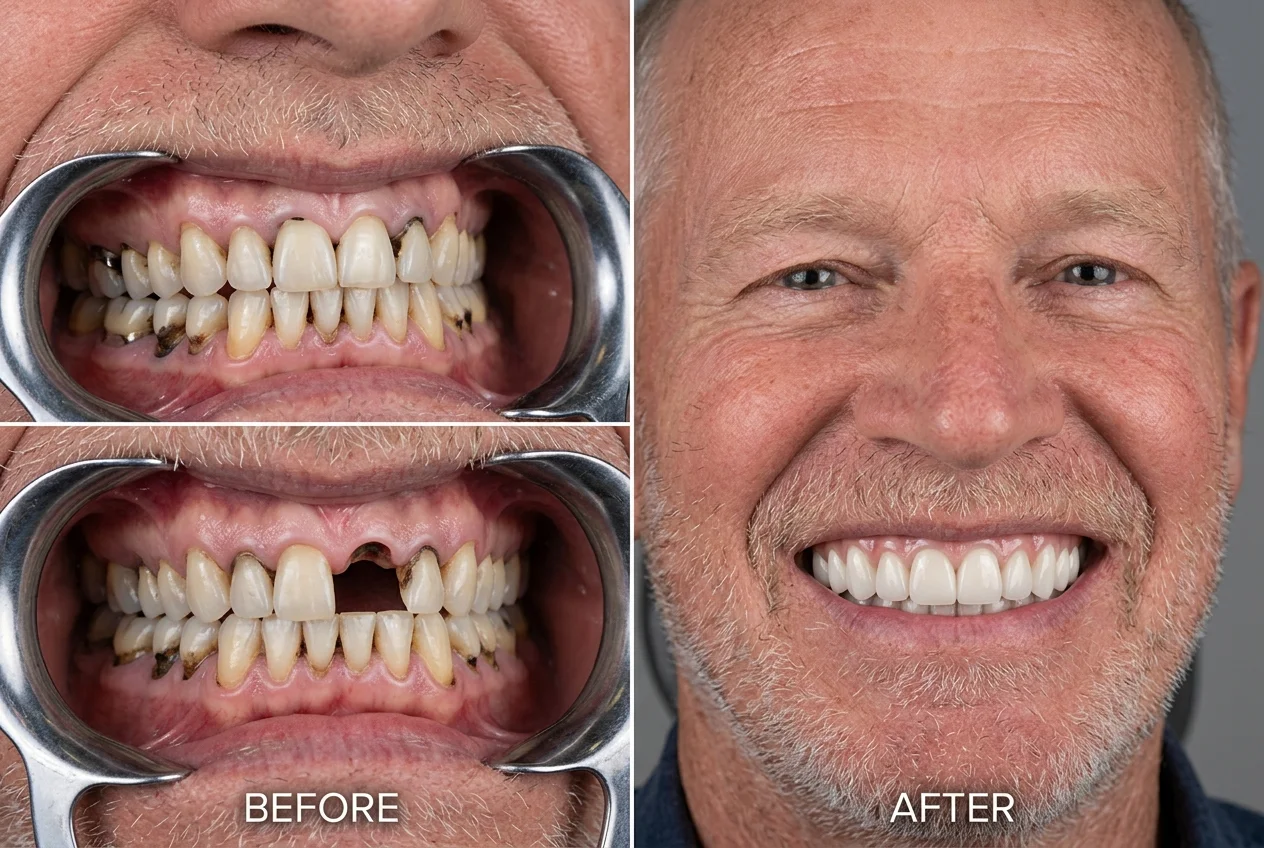
What Are the Potential Risks and Drawbacks of Full Arch Implants?
Key drawbacks of All-on-4 include a single point of failure where losing one implant can compromise the entire bridge, along with demanding hygiene requirements to prevent peri-implantitis.
While the benefits are highly compelling, a balanced review of all on 4 dental implants pros and cons must address the potential risks. Full arch dental reconstruction is a major surgical procedure, and understanding its limitations is essential to preventing postoperative disappointment or clinical failure.
The primary concern with a four-implant layout is load distribution. Because the entire chewing force is supported by only four pillars, the mechanical stress on each implant is high. If one implant fails to integrate or is lost due to peri-implantitis (gum infection), the entire bridge loses its structural foundation. In comparison, an All-on-6 restoration offers more safety redundancy, allowing the bridge to survive even if one implant encounters issues. You can explore the differences in our All-on-6 dental implants page.
To help you understand the risks, let us examine the main challenges associated with this protocol:
- Zero Failure Redundancy: If a single posterior implant fails, a new prosthesis must usually be fabricated.
- Surgical Skill Requirements: Precise placement is critical. Poor implant angulation can lead to bridge fracture or nerve damage.
- Speech Adjustments: The thickness of the artificial gum flange can temporarily alter speech, requiring a few weeks of practice to adjust.
- Esthetic Limitations: In patients with high smile lines, the transition line between the artificial bridge and natural gums may be visible if not properly designed.
How Do Bone Volume and Cleanliness Hurdles Affect Success?
Although All-on-4 bypasses the need for bone grafting in many cases, it still requires a minimum bone height and width to achieve primary stability. During your virtual assessment, our team evaluates your 3D CBCT scans to ensure there is enough bone density to secure the implants. Patients with severe osteoporosis may still require grafting before the surgery can proceed.
Furthermore, managing full arch implant complications requires a commitment to excellent oral hygiene. Food particles can easily gather beneath the prosthetic bridge. If not cleaned daily with water flossers and superfloss, bacteria will accumulate, leading to peri-implantitis. We advise patients to understand these maintenance responsibilities fully before planning their trip. If you have questions, please feel free to contact our clinical team directly.
How Do We Minimize All-on-4 Failures at Dental NKT?
Dental NKT minimizes All-on-4 complications through advanced 3D surgical guides, premium titanium brands, and comprehensive sterilization protocols.
At Dental NKT, patient safety and implant longevity are our highest priorities. We utilize advanced digital dentistry workflows to eliminate human error during placement. By combining 3D CBCT scans with intraoral digital impressions, we design custom surgical guides that determine the exact depth, angle, and position of each titanium fixture before surgery.
We only use premium implant systems from world-renowned brands like Straumann® (Switzerland) and Nobel Biocare® (Sweden). These systems are backed by extensive clinical studies and have the highest osseointegration rates in the industry. You can learn more about our technology on our advanced dental technology and equipment page.
Our sterilization protocols meet strict European standards. Our surgical suites are equipped with positive-pressure HEPA air filtration systems to maintain a completely sterile environment during surgery, reducing the risk of infection to near zero. Every procedure is performed by our lead implantologists, whose clinical credentials can be verified on our our dentists and clinical specialists page. To get an overview of our clinic, you can also return to our dental homepage.
Additionally, we back all our full arch reconstructions with a comprehensive warranty covering material defects. You can read our detailed terms on our global warranty policy and terms page to ensure peace of mind for your travel. You can find detailed treatment breakdowns on our All-on-4 dental services page.
What Are the Alternative Treatments to All-on-4?
Patients seeking full arch solutions can also explore implant-supported overdentures, traditional multi-unit implants, or zygomatic implants for severe bone loss.
When studying all on 4 dental implants pros and cons, it is helpful to look at alternatives. A removable implant-supported overdenture uses two to four implants and snap-on attachments, offering a cost-effective option that is easier to clean. However, it does not provide the same bite strength as a fixed zirconia bridge.
Another option is traditional multi-unit implants, which uses six to eight implants. This configuration spreads chewing forces more evenly and provides safety redundancy, but it often requires extensive bone grafting. For severe jawbone shrinkage, zygomatic implants anchor directly into the cheekbone, bypassing the jawbone entirely.
FAQ: What Is the Long-Term Success Rate of All-on-4?
According to clinical data, All-on-4 dental implants have a long-term survival rate exceeding 95% over a 10-year period when combined with proper maintenance and professional checkups.
Clinical data compiled from the Australian Dental Association (ADA) Implant Survey indicates that the cumulative 10-year survival rate of All-on-4 restorations is 95.2% for the maxilla (upper jaw) and 97.4% for the mandible (lower jaw). These figures prove that when performed by qualified surgeons, this protocol is highly predictable and durable.
To secure these high success rates for your smile, we recommend following these post-operative care steps:
- Use a Water Flosser: Essential for flushing out food debris trapped underneath the zirconia bridge.
- Bi-Annual Cleaning: Schedule professional cleanings twice a year to remove plaque buildup around the titanium posts.
- Wear a Nightguard: If you grind your teeth, wearing a custom nightguard protects the porcelain teeth from chipping.
- Quit Smoking: Smoking significantly increases the risk of implant infection and failure.
By understanding both the pros and cons of full arch dental implants, you can embark on your dental tourism journey with complete confidence. For a detailed breakdown of what to expect during your trip, visit our complete dental tourism travel guide.